April 20, 2026 • Margot Vellacourt • 9 min reading time • Prices verified June 3, 2026
PETKIT PuraMax 2 vs. Purobot Max Pro 2: AI Camera Worth the $165 Upgrade?
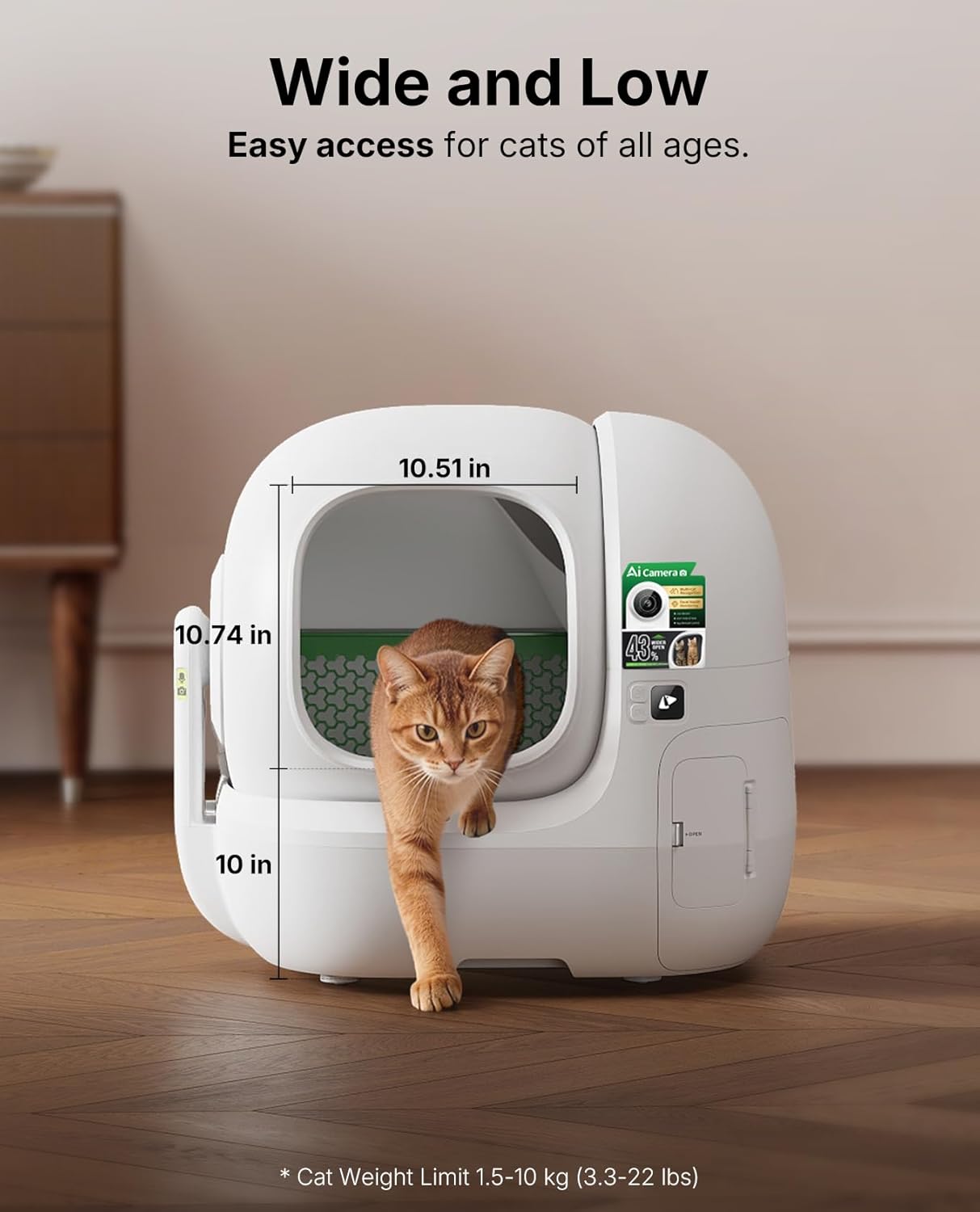
If you’ve been shopping for a self-cleaning litter box — that’s an automated unit that scoops, sifts, or rotates waste away from your cat’s litter without you having to pick up a scoop — you’ve probably already landed on PETKIT as a serious contender. The brand has carved out a reputation for well-priced hardware and a genuinely capable companion app. Right now, their lineup includes two premium globe-style units that look nearly identical at first glance: the PuraMax 2 (street price roughly $229–$249 as of May 2026) and the Purobot Max Pro 2 (street price roughly $394–$415). That gap — about $165 — buys you one marquee feature: a built-in AI camera that watches the inside of the globe during each visit. Before you dismiss that as a gimmick or assume it’s an obvious must-have, it’s worth slowing down. This article breaks down exactly what you get for that premium, when it earns its keep, and when you should save the money.
What You’re Actually Comparing
Both units share the same rotating-globe design — a large sphere that spins after your cat exits, tumbling clumps into a sealed waste drawer below. The globe accommodates most cats up to roughly 15 lbs, the waste drawer seals with a carbon filter, and both units connect to the PETKIT app via Wi-Fi for cleaning cycle control, usage logs, and odor management scheduling.
Here’s where they genuinely differ:
By the numbers:
- PuraMax 2 base price: ~$229–$249
- Purobot Max Pro 2 base price: ~$394–$415
- Price delta: ~$165
- Camera resolution (Purobot Max Pro 2): 1080p with infrared night vision
- AI identification (Purobot Max Pro 2): distinguishes individual cats by silhouette combined with weight reading; logs per-cat visit duration
- Weight sensor: present on both units; Purobot Max Pro 2 adds a visual confirmation layer on top of weight data
The $165 is not buying you a different motor, a larger globe, or a better waste drawer. It is buying you a camera, AI identification logic, and the visual data layer that sits on top of the weight-sensor readings both units already collect.
The Three Scenarios Where the Camera Decision Actually Splits
H3: Single Cat, No Known Health History
For a single-cat household where health monitoring is a background concern rather than an active one, the PuraMax 2 is the more defensible purchase. The weight sensor logs visit frequency and usage patterns reliably. The Spruce Pets, in their roundup “Best Self-Cleaning Litter Boxes,” has consistently noted that weight-sensor-equipped units in the $200–$300 range provide sufficient behavioral baseline data for most single-cat owners — and that camera features, while useful, represent a meaningful jump in price that not every household needs.
The honest reality: if you check the PETKIT app once a week, the camera’s timestamped visit footage loses most of its value. The camera earns its cost only when an owner is actively watching patterns. If your single cat is young, healthy, and your monitoring habit is casual, the $165 is better directed toward a full year of consumables.

PETKIT
$299.99
In stock on Amazon
Check price on AmazonH3: Multi-Cat Household, Cats Close in Weight
This is where the camera math shifts most clearly in the Purobot Max Pro 2’s favor. The PuraMax 2, like most weight-sensor-only units, tracks visits and weights — but in a two- or three-cat household, attributing a reading to a specific cat relies entirely on the system distinguishing between animals that may be close in size. Owners in multi-cat homes consistently report that per-cat attribution on weight-only systems becomes unreliable when cats are within 1–2 lbs of each other.
The Purobot Max Pro 2’s AI camera adds a visual silhouette layer, which meaningfully improves per-cat identification accuracy in these cases. If you have three cats and you’re trying to determine whether your 9-lb senior is visiting the box normally versus your 10-lb adult, that accuracy difference is operationally significant. Apartment Therapy, in their feature “The Best Automatic Litter Boxes We’ve Found,” specifically flags per-cat tracking accuracy as one of the key differentiators owners should evaluate when a household has more than two cats — and notes that camera-assisted identification is currently the most reliable method available at the consumer price point.
PETKIT
$465.99
In stock on Amazon
Check price on AmazonH3: Cat With an Active Health Condition
If you have a cat with a diagnosed urinary, renal, or digestive condition — or a senior cat whose vet has specifically told you to monitor litter box behavior — the Purobot Max Pro 2’s camera is the easiest $165 to justify in this comparison. PetMD, in their guidance document “How to Monitor Your Cat’s Health at Home,” identifies litter box behavior changes as among the earliest observable indicators of illness in cats, noting that visit frequency, duration, and apparent output are all signals owners should track. A weight sensor catches frequency and approximate output; a camera catches posture, duration, and whether a visit produced anything visible at all.
iHeartCats, in their article “Do Automatic Litter Boxes Really Track Cat Health?,” makes the appropriate caveat clearly: the value of app-based monitoring is pattern recognition over time, not real-time diagnosis. The camera accelerates your ability to spot a pattern — a cat spending 4 minutes in the box at 2 a.m. and producing nothing — but it does not replace the vet visit that pattern should trigger. Owners who treat the camera as a diagnostic tool rather than a monitoring tool will be disappointed; owners who treat it as an early-warning layer will find genuine value.
PETKIT
$465.99
In stock on Amazon
Check price on AmazonConsumables and True Cost of Ownership
Neither unit should be evaluated on sticker price alone. Both the PuraMax 2 and Purobot Max Pro 2 use PETKIT’s proprietary waste drawer liners and replacement carbon deodorizer balls, and ongoing costs accumulate in ways that aren’t obvious upfront.
Waste drawer liners for both units run approximately $15–$18 for a pack of 12. A moderately active single-cat household goes through roughly one liner per week to ten days depending on cleaning frequency and litter type — approximately $65–$85 per year in liners alone. Carbon filter replacements, which PETKIT recommends swapping every 30 days, add roughly $8–$12 per replacement set, or another $96–$144 annually.
Across a 24-month ownership window, consumables for either unit land in the $180–$230 range. This means the “cheaper” PuraMax 2 converges with the Purobot Max Pro 2’s total cost of ownership faster than the sticker price gap implies. This is not a reason to default to the Purobot Max Pro 2 — it is a reason to take the $165 hardware delta seriously rather than treating the decision as a simple sticker comparison. The camera either pays for itself in utility or it doesn’t; the consumables cost is identical either way.
Apartment Therapy’s coverage of self-cleaning litter boxes notes that PETKIT units are particularly popular in urban apartment settings because of their enclosed globe design and odor containment. Both units perform similarly on odor control — the camera does not improve that equation.
App Integration and Smart-Home Compatibility
Both units operate through the PETKIT app, which supports iOS and Android and offers cleaning schedule automation, usage history, and odor management controls. As of May 2026, neither unit natively integrates with Apple Home, Google Home, or Amazon Alexa — PETKIT operates through its own ecosystem rather than pushing into third-party smart-home platforms.
For owners who have built automation dashboards on Home Assistant or similar platforms, community-built PETKIT connectors exist but are unsupported by PETKIT and operate outside warranty coverage. If native smart-home integration is a firm requirement, the Litter-Robot 4’s more mature ecosystem compatibility is worth evaluating as an alternative to either PETKIT unit.
What the Purobot Max Pro 2 adds on the app side is the camera feed and AI analysis dashboard, which surfaces per-cat visit timelines, visit duration trends, and behavioral anomaly flags. The app interface is widely described as clean and functional. One practical note for new owners: the AI anomaly alert system tends to over-fire during the first few weeks of use while it establishes behavioral baseline data. Owners report this calibration period typically runs 2–3 weeks for single-cat households and 3–4 weeks for multi-cat homes. If a 3 a.m. false-alarm notification during week two will genuinely frustrate you, factor that into your decision.
The Decision Framework
Buy the PuraMax 2 (~$229–$249) if:
- You have one cat, or two cats with a meaningful weight difference (3+ lbs apart)
- Health monitoring is nice-to-have rather than a primary use case
- You’re upgrading from a first-gen PuraMax or a sub-$200 unit and primarily want better build quality and app control
- You want to hold $165 in reserve for a year’s worth of consumables or a vet visit if something actually looks off
Buy the Purobot Max Pro 2 (~$394–$415) if:
- You have 2–4 cats, especially any pair within 1–2 lbs of each other
- You have a cat with a known urinary, renal, or digestive condition where litter box behavior is an active monitoring signal your vet has asked you to watch
- You are the type of owner who will open the app daily and act on what the visit timeline shows — if you check weekly, the camera data loses most of its value
- The $165 is genuinely within your budget and you understand the 2–3 week calibration period before alerts become reliably signal rather than noise
Consider the Litter-Robot 4 instead if:
- Native Apple Home or Alexa integration is non-negotiable
- You prioritize a longer warranty and more established U.S.-based support infrastructure
- Your household has cats consistently over 15 lbs
Bottom Line
The Purobot Max Pro 2’s AI camera is a real feature that does what PETKIT claims — but like most monitoring technology, it earns its cost only when the owner is positioned to act on what it surfaces. The Spruce Pets, in their “Best Self-Cleaning Litter Boxes” roundup, has placed PETKIT’s mid-range globe units among the more durable options in the $200–$400 segment, and that hardware reputation holds across both units here. What you’re deciding is not which unit is better built — they’re effectively equivalent on that dimension — but whether the camera layer pays for itself in your specific household.
For a multi-cat household with a senior cat or a cat with a health history, the $165 is genuinely defensible and the camera will likely surface something actionable within the first year of ownership. For a single healthy cat whose owner checks the app occasionally, the PuraMax 2 is the more honest value, and the money is better directed toward consumables and a proactive vet visit. Now you have the math to answer that honestly for your household.