April 6, 2026 • Margot Vellacourt • 8 min reading time • Prices verified June 3, 2026
3 Cats, 1 Box: How to Pick a Self-Cleaning Litter Box for a Multi-Cat Home
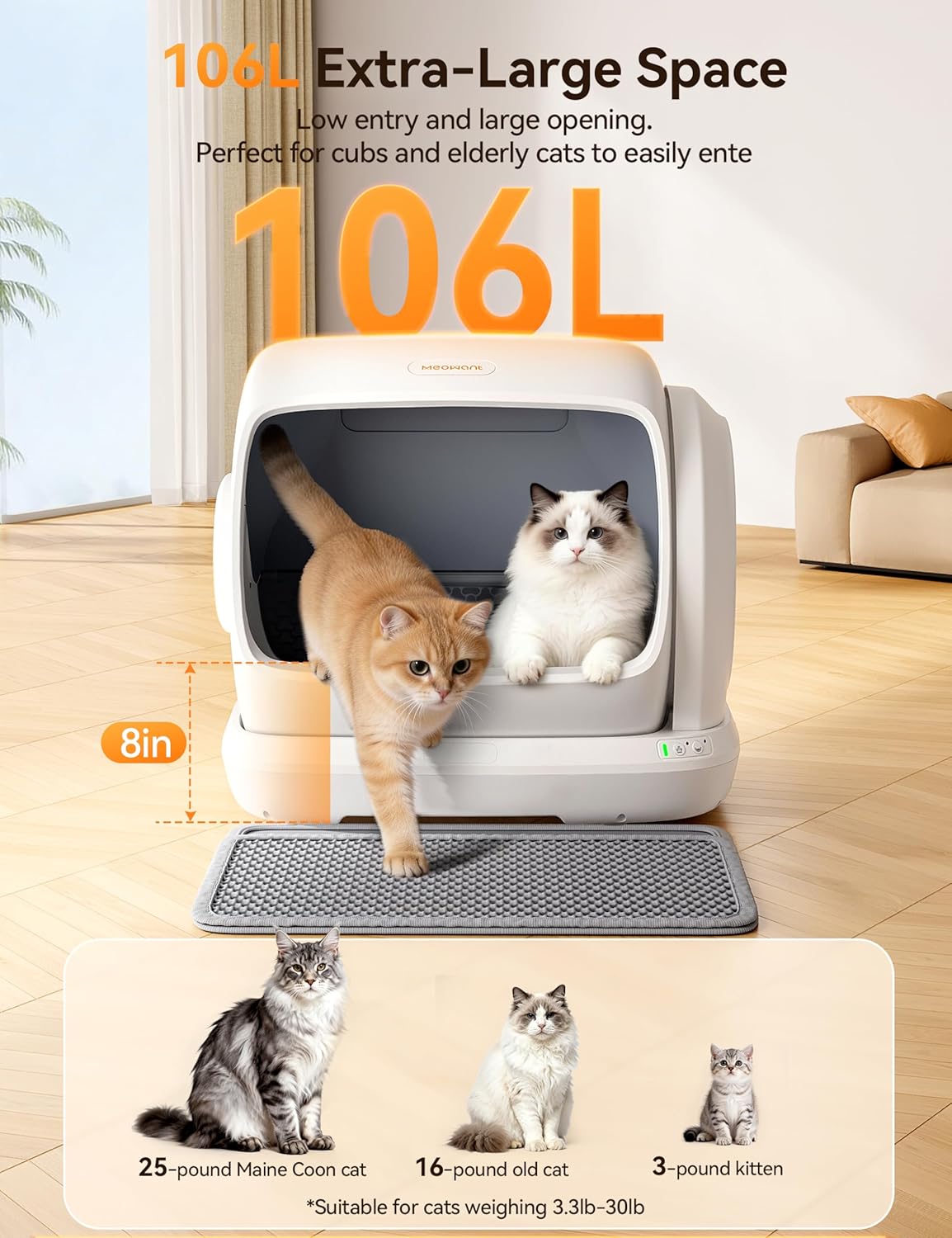
A self-cleaning litter box is exactly what it sounds like: a motorized unit that detects when your cat has used it, waits a few minutes, then automatically sifts or rotates the waste into a sealed drawer or bag — so you’re not scooping multiple times a day. For a single cat, the math is straightforward. For two, three, or more cats? The math gets complicated fast, and the wrong choice turns a $500 purchase into a smelly, overworked appliance that quits on you inside twelve months. This guide is built specifically for multi-cat households — people who already know automated boxes exist and are trying to figure out which unit can actually carry the load, what the real five-year cost looks like, and whether the N+1 rule (the veterinary standard that says you need one litter box per cat, plus one extra) still applies when those boxes cost $500 apiece.
Spoiler: it does, and we’ll show you the math that makes it manageable.
| EDITOR'S PICK[Neakasa M1 Plus Open-Top Self-C…](https://www.amazon.com/dp/B0CSKBWBF6?tag=greenflower20-20) | Mid-tier[Furbulous True Odor-Free Automa…](https://www.amazon.com/dp/B0FDKBLSGM?tag=greenflower20-20) | Budget pick[UBPET Self Cleaning Cat Litter…](https://www.amazon.com/dp/B0G2PJW6YF?tag=greenflower20-20) | |
|---|---|---|---|
| Capacity | — | — | XXXL |
| Sensors | 360° Safety Sensors | — | Weight Sensors |
| Odor Control | Advanced Odor & Leak Control | True Odor-Free | Odor Control |
| App Control | ✗ | ✓ | ✓ |
| Refill Bags | 2 Rolls | Self-Pack and Refill System | — |
| Weight Limit | — | 3.3-22 lbs | — |
| Price | $449.99 | $329.99 | $305.99 |
| See on Amazon → | See on Amazon → | See on Amazon → |
The Real Problem: Cycle Rate, Waste Capacity, and Why Most Units Fail at Scale
When reviewers call a unit “great for multi-cat homes,” they often mean it survived two cats, not that it was designed for three or four. The two specs that actually determine multi-cat viability are cycle rate (how many cleaning cycles the motor can handle per day without overheating or stripping gears) and waste drawer capacity (how many days’ worth of waste the sealed bin holds before you have to empty it).
PetMD’s guidance on litter box needs notes that a three-cat household should ideally have four boxes — which means if you’re consolidating to automated units, each machine is handling a significantly higher-than-average usage load. Companion Animal Psychology’s published research on multi-cat litter behavior reinforces that cats will avoid a box they perceive as “claimed” by another cat, meaning frequent cycling isn’t just a hygiene preference — it directly affects whether all three cats actually use the unit or start finding creative alternatives.
Here’s where the field separates into tiers:
By the numbers — cycle capacity and drawer life at 3-cat load:
| Unit | Rated Cycle Capacity | Waste Drawer (est. days, 3 cats) | Replacement Waste Bags |
|---|---|---|---|
| Litter-Robot 4 ($699) | Unlimited (per Whisker) | ~7–10 days | ~$0.50/bag |
| Litter-Robot 3 Connect ($499) | Unlimited (per Whisker) | ~5–7 days | ~$0.50/bag |
| PETKIT PURA MAX ($169) | High-frequency, unspecified | ~4–6 days | Proprietary liner, ~$0.65/liner |
| PetSafe ScoopFree Ultra ($129) | ~5–10 cycles/day rated | ~7–14 days (crystal tray) | Crystal tray, ~$20/tray |
The Litter-Robot line — both the 3 Connect and the newer 4 — is the only category where Whisker’s published documentation explicitly states no maximum daily cycle limit. That’s not a marketing promise you should accept at face value, but aggregated owner reviews across both iHeartCats and The Spruce Pets consistently report these units running cleanly through heavy 3–4 cat households for 24+ months without motor failure, which is the real-world corroboration that matters. The PETKIT PURA MAX at $169 is competitive on paper, but owners in long-run reviews note that the motor shows signs of wear under sustained high-frequency use more often than the Whisker units do.
The N+1 Rule vs. the One-Box Fantasy
Apartment Therapy’s veterinary survey makes the case plainly: the N+1 rule isn’t just a polite suggestion. In a three-cat home, you need four litter boxes, full stop. That rule doesn’t evaporate because the box is self-cleaning — it shifts.
What automated boxes do change is the effective cleanliness per unit. A Litter-Robot 4 that cycles within seven minutes of each use functions more like a perpetually fresh box than a traditional scooped box does, even after twelve hours of neglect. Modern Cat’s multi-cat litter coverage notes that perceived cleanliness — how fresh a box smells and looks to the cat — matters as much as the raw number of boxes available. A single high-frequency, well-maintained automated unit can functionally satisfy one or two cats in a way that two neglected manual boxes cannot.
The practical translation for a three-cat household:
- Two automated units is the realistic minimum. One as primary, one as backup — and you’ll likely find that all three cats develop a preference for one over the other, which is normal and not a problem as long as both stay clean.
- Three automated units is the gold standard, but at $699 each for Litter-Robot 4s, that’s a $2,097 upfront investment. That number is real, and if it makes you flinch, that’s information: the math might point you toward two LR4s plus one reliable manual box rather than three premium automated units.
- One automated unit for three cats is almost always a mistake. The cycle queue backs up during peak morning and evening use windows, cats start waiting or avoiding, and you’re back to the behavioral problems you bought the unit to solve.
Matching Units to Household Type: The Decision Frame
This is where the guide gets prescriptive, because “it depends” is not useful when you have a purchase decision pending.
If you have 3 cats and a $1,000–$1,500 budget for the full setup: Two Litter-Robot 4s is the configuration most worth the money. The Whisker app — which runs on iOS and Android and connects to both units — gives you per-cat usage data and weight trends that The Spruce Pets has noted are genuinely useful for early detection of urinary issues in multi-cat homes where it’s otherwise hard to know which cat is using the box how often. Refurbished LR4 units through Whisker’s own certified-refurb program typically run $489–$549 as of early 2026, which meaningfully changes the math. Two refurbs plus the Whisker Connect subscription ($4.99/month) gets you into the full health-monitoring ecosystem for roughly $1,050–$1,150 — call it a realistic entry point.
If you have 2 cats with plans to add a third, and a $400–$700 budget: The Litter-Robot 3 Connect at $499 (new) or ~$349 refurbished is the right single-unit purchase, bought with the understanding that you’ll add a second unit when the third cat arrives. The LR3 Connect’s app connectivity is slightly less refined than the LR4’s — the LR4 added OmniSense detection and a higher-resolution waste-level indicator — but for a two-cat household it performs comparably in real-world owner reports, and the $150–$200 you save can go toward the second unit fund. Don’t let perfect be the enemy of operational.
If your budget is $200–$350 for the whole setup: Be honest with yourself: at this price point, no automated unit has a demonstrated multi-cat track record that holds up past 12–18 months under heavy use. The PETKIT PURA X ($199) is the strongest performer in the sub-$250 tier — Modern Cat and iHeartCats both cite it as the entry-level unit most likely to survive year two — but “most likely” in a field where most don’t is a low bar. If budget is the hard constraint, buy one PETKIT PURA X for your highest-traffic area and keep one traditional box clean and scooped twice daily as the second position. That hybrid approach is more honest than spending $300 on two sub-$200 units that both fail.
If you’re in a small apartment with aesthetic constraints: The Litter-Robot 4’s matte white enclosure and relatively contained 22-inch footprint make it the easiest unit to integrate into a designed space — owners in Apartment Therapy’s coverage of litter solutions consistently call it out as the one automated unit that doesn’t look like a biohazard appliance. The PETKIT PURA MAX is smaller and arguably more neutral in finish, but its smaller waste drawer (real problem in a multi-cat home) and less proven long-run motor record make it a secondary recommendation here.
True Cost of Ownership: The Number You Need to Run
The sticker price is the least important number in this decision. Here’s what a two-LR4 setup actually costs over five years in a three-cat household, based on published consumable pricing as of May 2026:
- Two LR4 units (refurb): ~$1,050 upfront
- Waste bags: ~$0.50 × 2 bags/week × 104 weeks = ~$104/two years, $260/five years, per unit × 2 units = ~$520
- Carbon filters (recommended every 3 months per Whisker documentation): ~$14/pack × 20 replacements × 2 units = ~$560
- Whisker Connect subscription: $4.99/month × 60 months = ~$299
- Total five-year cost: ~$2,429
For comparison, a manual scooping approach with a quality clumping litter across three cats runs roughly $600–$800/year in litter alone — $3,000–$4,000 over five years, plus your time. The automated two-unit setup is actually cost-competitive on a five-year horizon if you value your time at more than zero. That math comes from the site’s own modeling based on published consumable pricing, not manufacturer estimates.
The Decision Rule
If you have three cats and you’re ready to commit: buy two units, not one. The specific units should follow from your budget.
- $1,000+ available: Two Litter-Robot 4s (refurb or new), Whisker app, done.
- $600–$999: One LR4 or two LR3 Connects; add the second unit within 6 months.
- Under $600: One PETKIT PURA X plus one traditional box, with a realistic upgrade plan in 18 months.
If you’re holding out for a single premium unit to “handle everything”: don’t. Every aggregated review source — The Spruce Pets, iHeartCats, Modern Cat — lands in the same place: one box for three cats creates behavioral problems that no self-cleaning motor can fully compensate for. The N+1 rule, backed by Companion Animal Psychology’s published behavioral research, is the one constraint that technology hasn’t overridden. Work with it, not around it, and you’ll spend less on replacement units over the next five years than the household that buys one flagship unit and watches it fail under load by month fourteen.