May 6, 2026 • Margot Vellacourt • 9 min reading time • Prices verified June 3, 2026
The 30-Day Return Window Playbook: Getting Your Cat to Actually Use the New Box
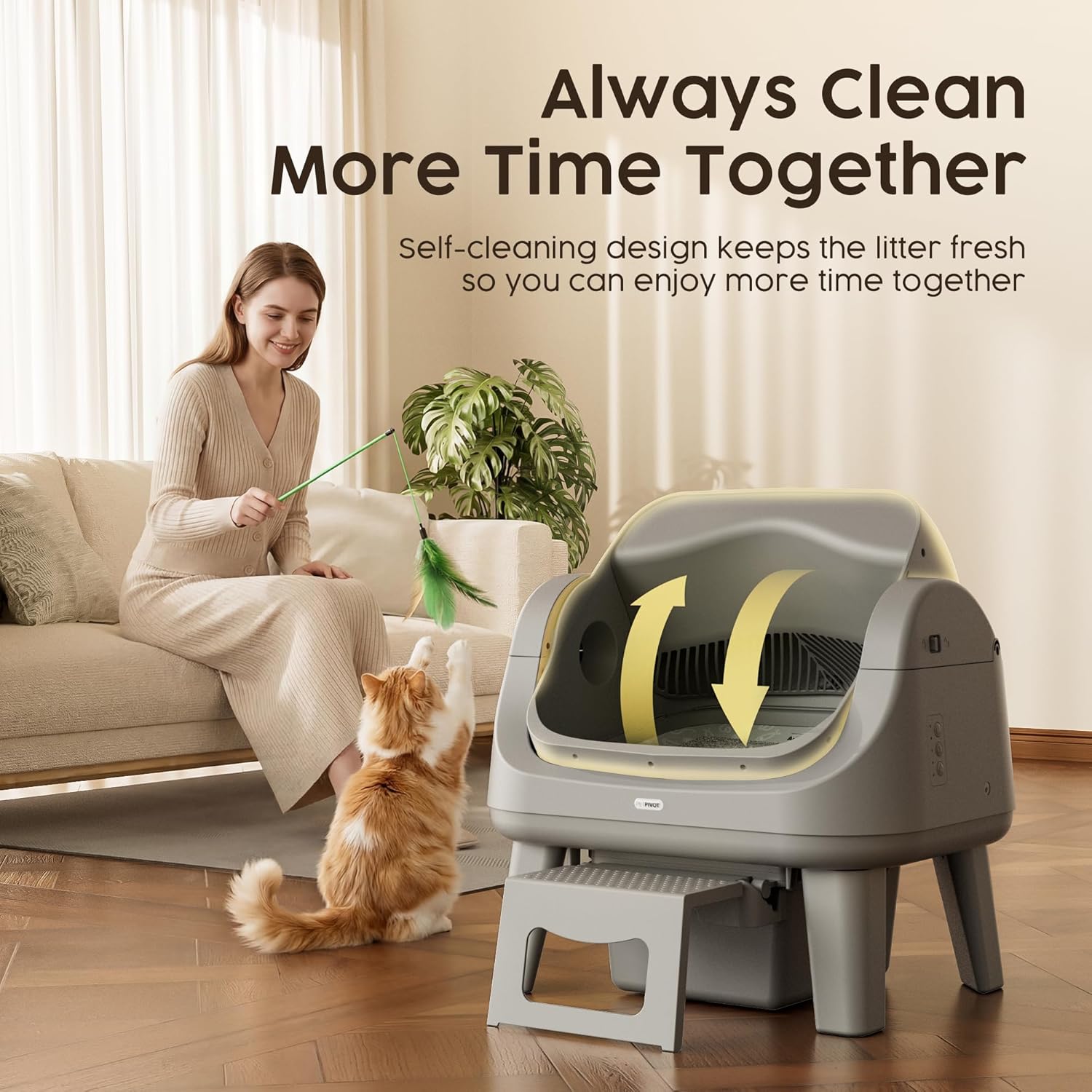
You just spent $499 on a self-cleaning litter box — a rotating globe on a base that detects when your cat steps out, waits a few minutes, then automatically tumbles the waste into a sealed drawer so you never have to scoop again. The idea is genuinely great. The reality, if you’ve already opened the box and set it up, is that your cat is currently sitting three feet away from it, staring at it like it insulted her grandmother.
This is normal. It is also time-sensitive. Most major retailers and manufacturers — Whisker (which makes the Litter-Robot line), PETKIT, PetSafe, and Amazon — offer return windows in the 30-to-45-day range. That window starts the moment your order ships, not the moment your cat finally steps inside. What follows is a week-by-week framework, drawn from aggregated owner reviews, published behavioral research, and manufacturer guidance, designed to get a reluctant cat using a new automated box before your return eligibility evaporates.
| EDITOR'S PICK[Litter-Robot 4 by Whisker](https://www.amazon.com/dp/B0FFDNZSHT?tag=greenflower20-20) | Mid-tier[PetPivot Self Cleaning Litter B…](https://www.amazon.com/dp/B0D8J5796M?tag=greenflower20-20) | Budget pick[Thereye Automatic Litter Box wi…](https://www.amazon.com/dp/B0FMF4G7MF?tag=greenflower20-20) | |
|---|---|---|---|
| App Control | — | — | ✓ |
| Warranty | 1 Year | — | — |
| Liners Included | — | ✓ | ✓ |
| Price | $699.00 | $159.99 | $149.99 |
| See on Amazon → | See on Amazon → | See on Amazon → |
Why Cats Refuse New Litter Boxes (And Why Automated Ones Are Harder)
Most cat owners have dealt with a litter box standoff at least once. A cat who was perfectly happy with her old box suddenly refuses the new one, or starts going just outside it, or disappears behind the couch in protest. Companion Animal Psychology’s overview of feline litter habits explains the core issue plainly: cats are neophobic — genuinely wary of new things — and the litter box sits at the intersection of two behaviors they guard intensely: elimination and territory. A new box isn’t just a new object. It’s a change in a ritual.
Automated boxes add two specific friction points that a standard plastic pan doesn’t. First, motor noise and movement. Even when a cycle isn’t running, most self-cleaning units emit a low hum or standby click. The Litter-Robot 4, for example, uses an OmniSensor array that the unit briefly activates when it detects motion nearby. Cats with noise sensitivity — older cats, rescues with trauma histories, cats who startle easily — can decide the machine is a predator before they’ve ever stepped inside it. Second, entry geometry. Units like the Litter-Robot 3 Connect and PETKIT PURA X have enclosed globes or domed entries with a single opening. Cats who prefer open pans or who have mobility limits (wide-bodied cats, seniors with arthritis) may find the entry physically awkward in addition to behaviorally strange.
The Spruce Pets’ guide to litter box avoidance notes that a cat who begins eliminating outside the box — even once — is significantly more likely to continue doing so if the trigger isn’t resolved quickly. That’s the real pressure the return window creates. You’re not just racing the calendar. You’re racing habituation before avoidance becomes a learned behavior.
The Week-by-Week Acclimation Framework
Week One: Parallel Placement, Power Off
Do not remove the old box. This is the single most common mistake owners report in aggregated reviews across PetMD forums and product Q&A threads. Your goal in week one is presence without pressure — the new unit exists in the environment but makes no demands.
Place the automated box in the same room as, or immediately adjacent to, the existing litter box. Keep the new unit powered off entirely. Sprinkle a small amount of used litter from the old box into the new one — the familiar scent signals “this is a safe zone.” Let the cat investigate on her terms.
If you have a multiple-cat household (the scenario where self-cleaning boxes pay off fastest, since manual scooping frequency scales with cat count), watch which cat investigates first. Bolder cats tend to acclimate earlier and can actually model the behavior for more anxious housemates.
By the numbers:
| Cat temperament | Typical first voluntary entry | First voluntary elimination |
|---|---|---|
| Bold / curious | Day 2–5 | Day 4–8 |
| Average / neutral | Day 5–10 | Day 8–15 |
| Anxious / senior | Day 10–18 | Day 15–25 |
These ranges are drawn from aggregated owner timelines reported across Apartment Therapy’s self-cleaning litter box coverage and PETKIT’s published acclimation guidance. They are not guarantees — a particularly skittish cat can exceed the upper bound.
Week Two: Power On, Cycles Disabled
If the cat has entered the new box voluntarily — even just to sniff around — you can plug it in during week two. The goal is ambient familiarity with powered presence before she ever has to experience a cleaning cycle.
Most units allow you to disable automatic cycles while still running the app and sensors. On the Litter-Robot 4, this is the “Wait Time” setting — you can push the cycle delay to its maximum (30 minutes) and then simply cancel any pending cycles manually via the Whisker app. On the PETKIT PURA X, app-controlled scheduling lets you turn off auto-clean entirely while keeping the odor system and occupancy sensors active.
Let the cat use the box in powered-but-stationary mode. She needs to learn that the machine doesn’t move while she’s inside it. This is the most important behavioral bridge. Vetstreet’s cat behavior resources emphasize that cats form strong associative memories around the elimination experience — one startling cycle while a cat is inside or immediately exiting can set acclimation back by a week or more.
If the cat hasn’t entered voluntarily by day 10, try moving the new box to the location of the old box and temporarily relocating the old box elsewhere. Location familiarity sometimes outweighs geometry anxiety.
Week Three: Supervised Live Cycles
By week three, the goal is first witnessed cycle acceptance — you want to be present the first few times the machine runs so you can observe the cat’s reaction without intervening unless genuinely necessary.
Run the first manual cycle when the cat is in the room but not using the box. Let her watch. Most cats will startle slightly, then approach to investigate the stopped globe. Owners consistently report that the investigation phase — sniffing the unit after a cycle — is a reliable positive signal. It means the cat has filed the machine under “strange but not threatening.”
If you have a multi-cat home, do not run cycles while any cat is within about six feet of the entry. The Litter-Robot 4’s safety system will pause if its sensors detect a cat, but the PETKIT PURA MAX at the sub-$200 tier uses a simpler infrared sensor that owners note can occasionally miss a cat who’s half-in, half-out of the entry. During supervised acclimation, manual oversight beats sensor reliance.
Begin transitioning away from the old box this week — not by removing it, but by not cleaning it as promptly. A slightly less appealing old box nudges preference toward the cleaner new one. This is the same principle PetMD’s litter box behavior guidance recommends when transitioning litter types: make the old option mildly less desirable rather than suddenly unavailable.
Week Four: Full Automation, Old Box Removal Decision
If the cat is using the new box regularly by day 21–24, week four is when you make the old box removal call. The general guidance from companion animal behaviorists is to wait until the cat has used the automated box on at least five consecutive days before removing the fallback.
If you’re at day 25 and the cat still hasn’t used the new box voluntarily, you are in the return-window red zone. This is the decision frame: a cat who has entered the box but not eliminated in it is a project worth continuing; a cat who has not entered voluntarily by day 25 is unlikely to flip before day 30 without a significant environmental change.
Common late-stage interventions that owners report producing results: moving the unit to a different room entirely (sometimes the original placement had an ambient stressor — a noisy appliance, a drafty vent); switching litter type to one with less scent variation from what the cat already accepts; and in anxious cats, a short course of feline pheromone diffuser (Feliway is the most commonly cited brand in owner forums) near the box to reduce environmental anxiety.
The Return Window: How It Actually Works (And Where It Traps Buyers)
Whisker’s current return policy (as of mid-2026) offers 90 days for Litter-Robot units purchased directly from Whisker.com — a meaningful buffer that takes the hardest time pressure off. But units purchased through Amazon or Chewy operate under those retailers’ own windows (typically 30 days for Amazon, 365 days for Chewy on many pet items). PetSafe’s ScoopFree Ultra ships with a 45-day satisfaction guarantee direct from manufacturer. PETKIT’s policy on the PURA X and PURA MAX sits at 30 days through most authorized sellers.
The trap that catches buyers: restocking fees and “opened box” clauses. Several authorized retailers apply a 15–20% restocking fee on returned large electronics, and a self-cleaning litter box that’s been used is unambiguously opened. Apartment Therapy’s buying guide coverage notes this explicitly for the Litter-Robot category — always confirm the exact return terms before purchasing, and screenshot or save the policy page at checkout, because retailer policies update without notice.
If you’re approaching day 28 with an unsuccessful acclimation, initiate the return conversation now — not on day 30. Customer service hold times, return label processing, and transit time all eat into your window.
If X, Then Y: Decision Rules at Day 30
Here’s how to frame the call:
If your cat has used the automated box voluntarily at least once in the past 10 days: Keep it. One successful use means the behavioral barrier has been crossed. Continued acclimation is a matter of weeks, not a fundamental incompatibility.
If your cat has entered the box but not eliminated in it, and you’re at day 25: Extend your effort by moving the unit’s location and eliminating the old box temporarily (hide it, don’t trash it) for 48 hours. This is a forcing function — use it carefully and only if your cat is otherwise healthy and not showing stress symptoms.
If your cat has not entered the box voluntarily by day 25: Initiate your return now. A cat who won’t cross the threshold at all after 25 days in a calm, parallel-placement setup is telling you something real about geometry, noise, or scent. That’s not a trainability failure — it’s data. Return the unit, evaluate whether a different form factor (open-top raking units like the PetSafe ScoopFree versus enclosed globes) would work better for your specific cat, and buy again with that information.
If you have a multi-cat household and some cats are using it, some aren’t: Don’t return. Keep the old box in service for the holdouts, watch whether the using cats’ visible comfort eventually converts the skeptics, and revisit removal in another 30 days. Multi-cat acclimation is rarely simultaneous — the Spruce Pets’ multi-cat litter guidance explicitly notes staggered adoption timelines as the norm, not the exception.
The $499 or $699 you spent on hardware is a sunk consideration once you’re inside the window. The only question that matters by day 28 is whether your cat is on a trajectory toward use, or whether you’re holding onto hope past the evidence. Know which one you’re in — and act accordingly.