April 27, 2026 • Margot Vellacourt • 8 min reading time • Prices verified June 3, 2026
Does Your Litter Box App Actually Give Your Vet Useful Data?
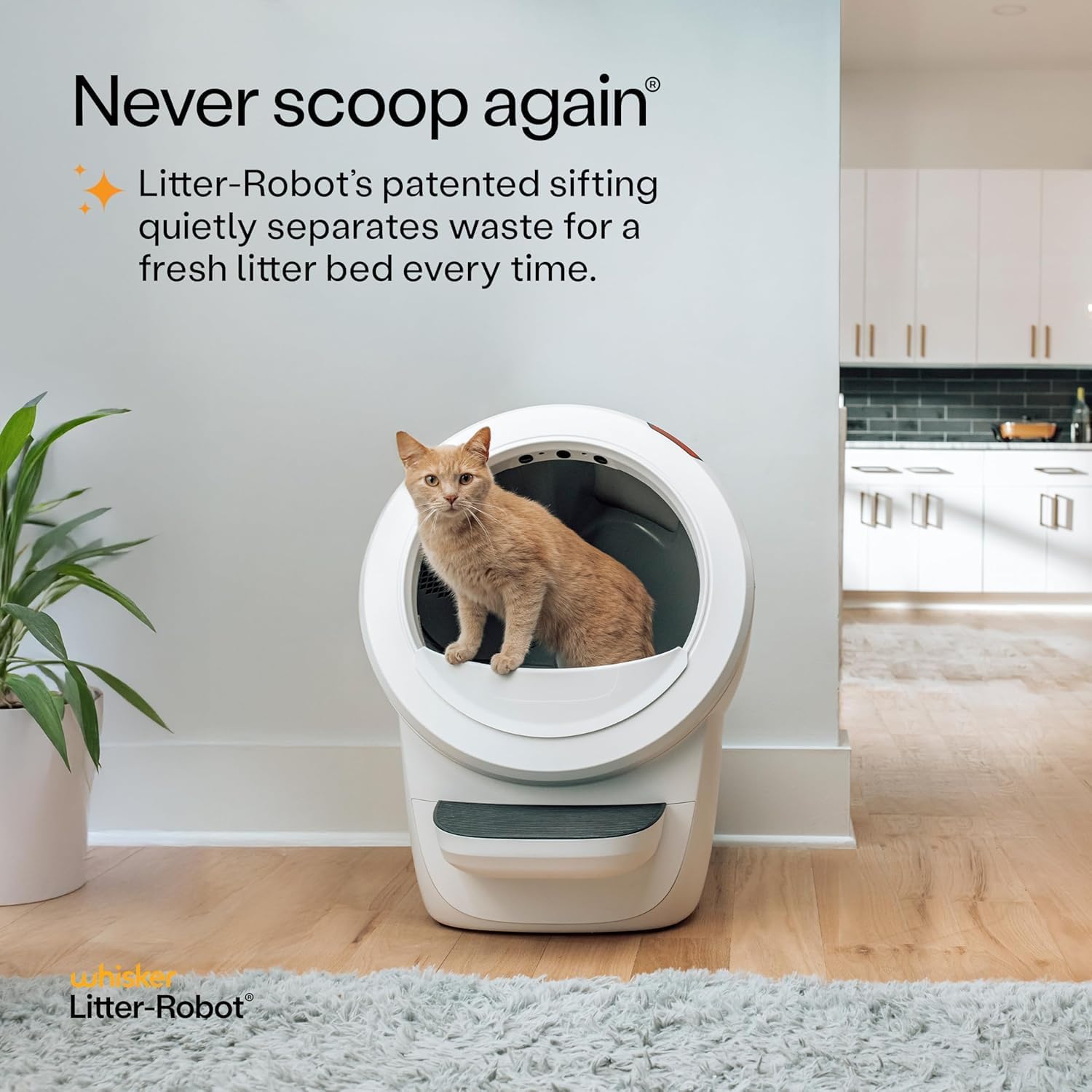
If you’ve been looking at smart, self-cleaning litter boxes — the kind that cost anywhere from $200 to $700 and connect to your phone — you’ve probably noticed one feature that gets highlighted heavily in the marketing: health monitoring. The idea is that a sensor in the box tracks each time your cat visits, how long they stay, and how much they weigh. The app logs it, graphs it over time, and can alert you when something changes. For multi-cat households especially, where it’s easy to lose track of which cat is doing what, that sounds genuinely useful. But there’s a question worth asking before you invest in the ecosystem: when you bring those app screenshots to your vet, do they actually help — or do they just look impressive?
This article is for owners who already understand the basic concept and are now trying to figure out how much clinical weight to give this data. We’ll name which metrics matter, which are more marketing than medicine, and what your vet would actually want to know versus what the app shows you. If you’re still deciding between units, the data quality differences between platforms factor into that decision — so we’ll show the math on that too.
What the Apps Are Actually Measuring (And What They’re Inferring)
The monitoring in today’s flagship units falls into roughly three categories:
Direct sensor measurements: Weight (via load cells in the base), visit duration (timed from lid-open to lid-close or motion detection), and visit frequency (number of cycles triggered per cat per day). These are the hardest numbers — they’re measuring something physical.
Inferred signals: Litter usage estimates, “health score” composites, and anomaly alerts. The Litter-Robot 4’s Whisker app, for instance, generates a “cat health insights” view that blends weight trends with visit cadence. PETKIT’s app produces similar composite scores. These are algorithmically derived — they’re the app’s interpretation of the raw numbers, not direct measurements.
Pattern flags: Alerts like “Simba visited 7 times today vs. her 3-visit average” or “weight dropped 4% this week.” These are the clinically interesting outputs, because they’re telling you about change, which is what medicine cares about.
Understanding this distinction matters before you bring anything to your vet. Raw sensor data and inferred scores are different things, and most vets will want the former.
The Data Your Vet Can Actually Use
Veterinary professionals, particularly internal medicine specialists, are increasingly enthusiastic about longitudinal home monitoring data — with caveats. Here’s what has genuine clinical utility:
Weight trends over time
This is the single most valuable output these apps produce. A scale built into a litter box isn’t a replacement for a clinic scale — it won’t match to the gram — but it doesn’t need to. What matters for early disease detection is trend, not absolute precision. According to Cornell Feline Health Center’s published resources on feline lower urinary tract disease and hyperthyroidism, unexplained weight loss is one of the earliest behavioral signals of multiple serious conditions, including hyperthyroidism, diabetes, and early-stage kidney disease. A graph showing a 5% weight decline over six weeks is something a vet can act on, even if the exact numbers differ slightly from clinic measurements.
The caveat: Multi-cat households break this. If two cats of similar size share one box, the weight sensor on a single-box setup cannot reliably disaggregate who is who. The Litter-Robot 4 uses cat recognition to attempt this, but owners in long-run reviews consistently report that cats of similar weight (within ~1 lb of each other) get misidentified with some regularity. If precision weight tracking is your clinical priority, a second box — or a dedicated feeding station with an integrated scale — is more reliable. PETKIT’s PURA MAX includes similar recognition features, with comparable reported limitations in households with closely matched cats.
Visit frequency and duration changes
PetMD’s overview of feline urinary issues notes that increased litter box visits, straining, or very short visits that produce little output are classic signs of urinary obstruction — a life-threatening emergency in male cats. If your app’s baseline is “Otto visits twice a day, average duration 90 seconds” and you suddenly see eight visits at 20 seconds each, that’s not a wellness trend — that’s a same-day vet call. VetStreet’s published guidance on reading litter box signals makes the same point: frequency and duration changes are the two behavioral signals most likely to reflect a real medical event.
The app doesn’t diagnose anything. But it surfaces the change fast, and it gives you a documented timestamp log that you can screenshot and show your vet. That’s genuinely useful.
Baseline documentation for new patients
One underrated use case: if you’ve adopted a new cat and spent 60 days with a smart box before their first wellness visit, you now have an objective behavioral baseline. Your vet knows what “normal” looks like for that specific animal, not just the species average. This is the kind of data that comes up years later when something changes — having the long history makes the deviation meaningful.
The Data That Looks Useful But Isn’t (Much)
“Health scores” and composite alerts
Every major app — Whisker, PETKIT, and others — wants to give you a single number or color-coded status. It’s a UX decision, not a clinical one. Composite health scores blend inputs using proprietary algorithms that aren’t peer-reviewed and aren’t disclosed in detail. Your vet cannot do anything with a number that says “85/100.” What they can use is the underlying components: “visits per day this week: 6.2, down from 10-week average of 3.1.”
When you bring data to an appointment, export or screenshot the raw graphs, not the summary screens.
Litter usage estimates
Some apps attempt to estimate how much litter a cat displaces per visit as a proxy for output volume. In the current generation of units, this is generally considered a rough heuristic, not a reliable measurement. The Spruce Pets’ review of the Litter-Robot 4 notes that the unit’s waste estimation is useful for knowing when to empty the drawer but doesn’t produce clinically precise output data. Don’t rely on it for medical conversations.
”Stress” indicators
A few app ecosystems flag behavioral patterns as potential stress signals — e.g., visiting at unusual hours or spending significantly more time in the box. These can be real signals, but they’re also easily confounded by schedule changes, new people in the home, or a cat who just likes to explore. Treat these as prompts to observe your cat directly, not as diagnoses.
By the Numbers: What Current Flagship Units Actually Log
| Unit | Weight tracking | Visit frequency | Visit duration | Cat ID in multi-cat | Data export |
|---|---|---|---|---|---|
| Litter-Robot 4 ($699) | Yes, with trend graphs | Yes | Yes | Yes (with accuracy caveats) | PDF/screenshot |
| Litter-Robot 3 Connect ($499) | Yes | Yes | Yes | No | Screenshot |
| PETKIT PURA MAX ($169) | Yes | Yes | Yes | Yes (similar caveats) | App export |
| PetSafe ScoopFree Ultra ($129) | No | No | No | No | None |
The ScoopFree Ultra — the most popular entry-level unit — collects no health data at all. If health monitoring is a real priority, it is not the right buy, regardless of price.
How to Actually Present App Data to Your Vet
Veterinarians are trained to work with objective history, not consumer app exports — but that doesn’t mean the data is unwelcome. The framing matters. Here’s a practical approach:
Lead with the change, not the app. Say “I have six weeks of weight data showing a consistent downward trend, and I can show you the graph” — not “my app’s health score dropped.” Vets respond to trends and events, not scores.
Print or screenshot the raw graphs. Most apps let you pull a 30, 60, or 90-day view of weight and visit frequency. That graph, printed or shown on your phone, is what a clinician can evaluate.
Note the multi-cat caveat proactively. If you have more than one cat using the box, say so. Your vet will immediately ask whether the data is cat-specific, and honest disclosure makes the data more credible, not less.
Use it as a prompt, not a diagnosis. “The app flagged more frequent short visits this week” is a reason to get the cat examined. It’s not a reason to decide they have a UTI and skip the appointment. The data improves triage; it doesn’t replace it.
The Decision Rule
If your goal is genuinely clinical — early detection, weight monitoring for a known-sick cat, behavioral baselines — the tradeoff is clear:
-
Single-cat household: Any unit with weight trending and visit logging (Litter-Robot 3 Connect, PETKIT PURA MAX, Litter-Robot 4) gives you clinically useful raw data. The $499–$699 range adds cat-ID refinement and better app UX, but the core data is available at the $169 tier.
-
Multi-cat household, health monitoring as priority: You either need one box per cat (the only way to get truly reliable per-cat weight data), or you accept that identification is probabilistic and supplement with other observational methods. No current app fully solves this.
-
Health monitoring as a nice-to-have, not a priority: The PetSafe ScoopFree Ultra collects nothing, but it’s $129 and reliable. If you’re not going to use the data, don’t pay the premium for it.
-
Already own a unit without health monitoring: Third-party pet scales (dedicated feeder scales, not the litter box itself) run $30–$80 and log weight to an app. That’s a reasonable supplement if your existing unit doesn’t log weight.
The apps are real tools. They’re not diagnostic instruments, and your vet will tell you the same thing — but the trend data they produce, especially weight and visit frequency, is exactly the kind of behavioral history that helps catch serious feline illness earlier than a once-a-year wellness visit ever could. Use the data as context and as a prompt. Let your vet do the interpreting.