April 27, 2026 • Margot Vellacourt • 9 min reading time • Prices verified June 3, 2026
Self-Cleaning Litter Boxes for Small Apartments: Footprint, Aesthetics, and Noise
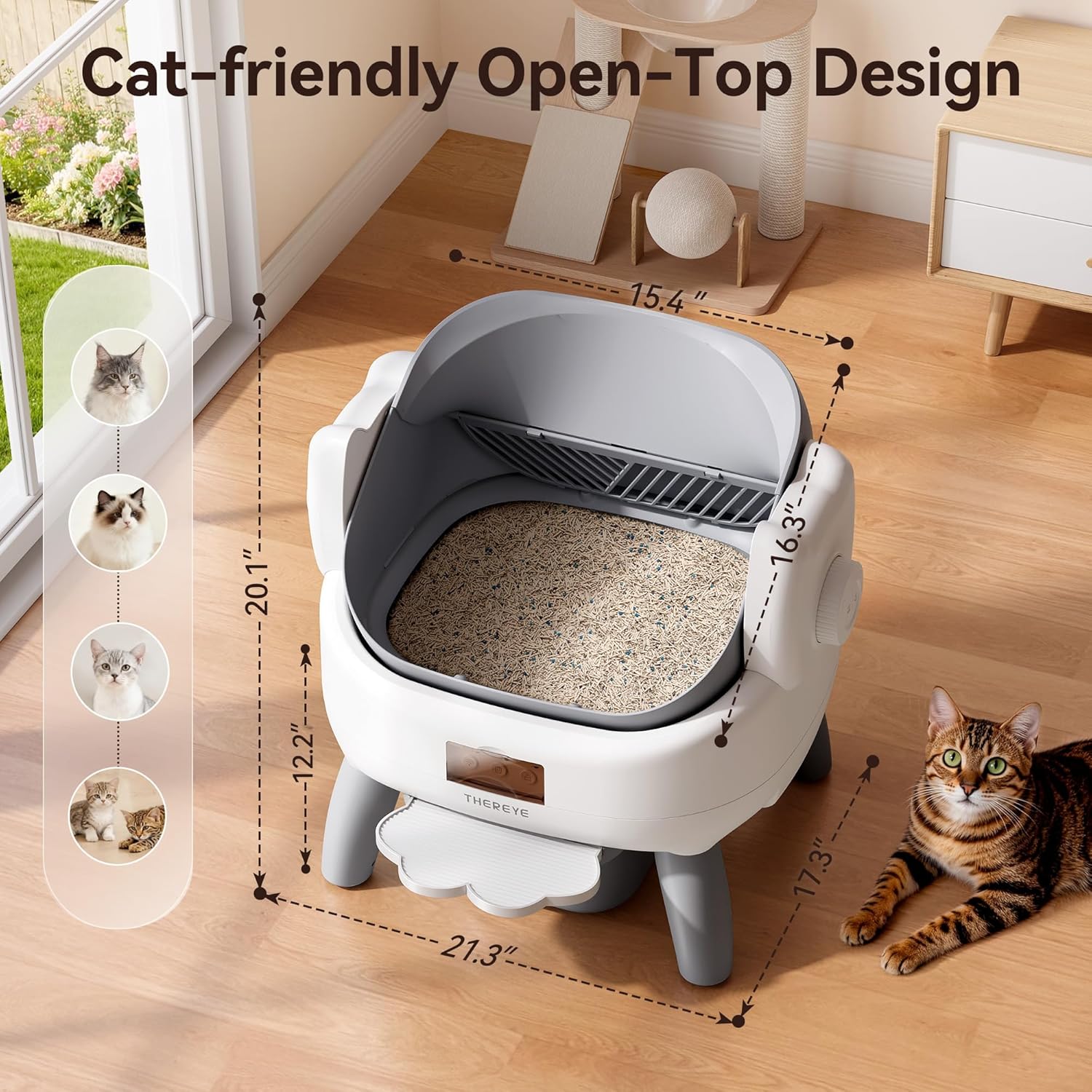
A self-cleaning litter box is exactly what it sounds like: a motorized unit that scoops, rakes, or rotates waste into a sealed drawer or bag after your cat finishes — so you’re not doing it manually two or three times a day. That automation matters in any home, but it matters especially in an apartment, where the litter box isn’t tucked in a basement or laundry room — it’s probably six feet from your couch. In that context, three things most buyers underestimate suddenly become the whole decision: how much floor space the unit physically takes up, whether it looks like lab equipment or furniture, and how loud the cleaning cycle is at midnight. This guide cuts through the spec sheets on those three axes specifically, with clear tradeoffs between the units most worth your money right now.
Footprint: What “Compact” Actually Means in Decibels of Floorspace
Most product pages list dimensions, but they rarely help you visualize what those dimensions mean next to a nightstand or inside a bathroom alcove. Let’s fix that.
The Litter-Robot 4 — Whisker’s flagship globe-style unit at $699 — measures roughly 22 inches wide × 27 inches deep × 29.5 inches tall. That’s not small. It’s closer in volume to a mini-fridge than to a side table. For a 700-square-foot studio, that’s a meaningful commitment of real estate, and reviewers at Wirecutter’s 2025 automatic litter box guide note that the globe’s vertical height is actually less of a problem than its depth — it’s the front-to-back dimension that eats into walkways.
By contrast, the PETKIT PURA X (around $199) is notably more apartment-friendly on paper: roughly 20 inches wide × 20 inches deep × 24 inches tall. That 7-inch reduction in depth is the difference between fitting in a bathroom corner and blocking the vanity. The Spruce Pets’ 2025 self-cleaning litter box roundup consistently flags the PURA X as one of the more space-efficient globe-style options under $300, though owners report the waste compartment fills faster with two cats than the spec sheet implies.
The PetSafe ScoopFree Ultra (around $129) is the outlier here: it uses a flat, open-tray design — roughly 27 inches long × 19 inches wide × 7 inches tall — that’s actually longer than a globe unit but dramatically shorter. In apartments where vertical clearance under a shelf or inside a furniture piece matters, that low profile is a genuine advantage. Apartment Therapy’s guide on hiding litter boxes in small spaces specifically calls out flat-tray self-cleaners as the easiest to integrate into furniture hacks (litter box enclosures, converted side tables), precisely because of this height.
The tradeoff to name explicitly: Globe units contain odor better and look more contained visually, but they have an irreducible cubic volume. Flat-tray units have a smaller perceived height but spread wider and offer almost no odor containment on their own. For an apartment bedroom, globe almost always wins. For a bathroom with limited vertical clearance, flat-tray may be the only option that fits.
By the Numbers
| Unit | Width | Depth | Height | Price (MSRP, May 2026) |
|---|---|---|---|---|
| Litter-Robot 4 | 22 in | 27 in | 29.5 in | $699 |
| PETKIT PURA X | 20 in | 20 in | 24 in | $199 |
| PETKIT PURA MAX | 21 in | 21 in | 26 in | $169 |
| PetSafe ScoopFree Ultra | 27 in | 19 in | 7 in | $129 |
Aesthetics: Which Units Actually Belong in a Designed Space
If you’ve spent money on your apartment’s look — a specific couch, a gallery wall, a considered color palette — a beige plastic orb the size of a basketball is going to bother you. This is a real consideration, not a vanity one. PetMD’s overview of litter box stress in cats notes that boxes placed in high-traffic, visually chaotic areas get used less consistently — meaning aesthetics and placement interact directly with your cat’s behavior.
The Litter-Robot 4’s matte finish (available in black, white, and a limited lunar grey) is the clearest case study in a manufacturer understanding its design-conscious audience. Modern Cat’s 2025 roundup of design-forward cat products specifically calls out the LR4’s industrial-minimal silhouette as one of the few automated litter boxes that reads as “deliberate object” rather than “medical device.” It’s tall enough to function as a visual anchor in a corner — which, counterintuitively, makes it easier to place in a living space than something you’re trying to hide.
The PETKIT PURA X and PURA MAX both come in white or a warm off-white that photographs well and blends with modern Scandinavian or all-white kitchens. They don’t have the sculptural confidence of the LR4, but they don’t fight the room either. Owners in long-run reviews describe them as “appliance-like” — which is fine if your apartment has stainless appliances but feels clinical next to warm wood tones.
The PetSafe ScoopFree Ultra is, honestly, difficult to place aesthetically. The open tray is functional-industrial in a way that most apartment owners end up enclosing in a furniture solution — a converted IKEA cabinet is a common approach flagged repeatedly in Apartment Therapy’s coverage. Budget for that enclosure (typically $40–$120 for a DIY piece) when you’re calculating true cost. Without it, the ScoopFree reads as utilitarian hardware, which works in a laundry room and nowhere else in a designed space.
Decision frame: If your apartment has a design identity you care about, the Litter-Robot 4 is the only unit in this category that earns its place as a visible object. The PETKIT units are neutral enough to tolerate. The ScoopFree needs a furniture cover to be livable — factor that cost in upfront.
Noise: The Real Apartment Test (Especially After 11 p.m.)
This is where apartment living changes the math entirely. In a house, a loud cleaning cycle at 3 a.m. is a curiosity. In a studio or one-bedroom, it’s an alarm. And most product pages are vague to the point of useless on decibel ratings.
Here’s what aggregated owner reporting tells us — not manufacturer claims:
The Litter-Robot 4 runs its rotation cycle in roughly 60–90 seconds. Owners consistently report the globe’s motor as a low hum — Wirecutter’s 2025 guide describes it as “roughly equivalent to a quiet dishwasher cycle” — but the key variable is litter type. Heavier clay litters amplify the rattling sound as waste tumbles inside the globe. Owners in apartment settings who switch to a lighter-weight litter (or a quieter clumping formula) report meaningfully reduced noise. The LR4 also allows a customizable delay — you can set it to wait 30 minutes after your cat exits before cycling, which means scheduling cycles to avoid your lightest sleep window.
The PETKIT PURA X uses a similar globe-rotation mechanism and is generally rated slightly quieter than the LR4 by owners in the $150–$250 price tier — The Spruce Pets’ roundup describes user-reported noise as “comparable to a small desk fan.” The PETKIT app also allows cycle scheduling, which is the correct way to handle an apartment sleep situation: set it to run at 7 a.m. and 7 p.m. and stop worrying about it.
The PetSafe ScoopFree Ultra uses a slow-moving rake mechanism that drags across the litter surface. Owners report this as a distinctly mechanical “scraping” sound that, while not loud, has a quality that carries through walls better than the low hum of a globe motor. In a studio where the unit is in the same room you sleep in, this is the wrong choice — the sound pattern is more intrusive than its decibel level suggests.
The practical rule: Globe-style units (LR4, PURA X) are meaningfully more apartment-compatible for noise because their sealed rotation contains the sound and they offer cycle scheduling. Rake-style units are cheaper but harder to sleep near. If you’re choosing a rake-based unit specifically to save money, set the delay to maximum and position the unit as far from your sleeping area as your floorplan allows.
The True-Cost Framing for Apartment Buyers
A few recurring cost realities that matter more in apartments than houses:
Replacement liners and waste drawers are the ongoing tax on the ScoopFree’s low sticker price. PetSafe’s proprietary crystal litter trays run approximately $15–$20 each and are recommended for replacement every 30 days per cat. For a two-cat apartment, that’s $360–$480 annually in consumables — closing the gap with a Litter-Robot 4 faster than most buyers expect. Wirecutter’s 2025 guide flags this explicitly as the ScoopFree’s structural weakness for multi-cat households.
Carbon filter replacements (standard on the LR4 and PETKIT units) run $10–$25 per replacement with a typical 3-month cycle — modest enough to ignore but worth including in a 5-year cost model.
App-based scheduling is worth naming as a value driver specifically for apartments: the ability to block out quiet hours isn’t just comfort — it means the unit can run more frequently during the day (better odor control) without the noise tax at night. Both the LR4 and PETKIT apps offer this; the ScoopFree does not.
The Decision Rules
If your apartment is under 600 square feet and you sleep in the same room as the litter box: the PETKIT PURA X is the call. It’s the most footprint-efficient globe-style unit with app scheduling and tolerable noise. Save the $500 difference versus the LR4 for something your apartment actually needs.
If you have a dedicated corner or nook, care about your interior design, and have $699 to commit: the Litter-Robot 4 earns it — not because it’s dramatically better mechanically, but because it’s the only unit that belongs in a designed space without apology. The app-based health monitoring (weight tracking, visit frequency) also produces data that Modern Cat and PetMD both note is clinically useful for early detection of issues like urinary changes or weight loss in cats.
If you’re at the entry level and genuinely cannot spend more than $130: the PetSafe ScoopFree Ultra works for one cat in a bathroom it doesn’t need to share. Budget $60 for a furniture enclosure and run the numbers on liner costs before your return window closes. For two cats in an apartment, skip it — the consumable math doesn’t land.
The bottom line across all three tiers: in a small apartment, noise scheduling and physical depth matter more than any single feature a spec sheet leads with. Measure your corner first, price out five years of consumables second, and only then let aesthetics be the tiebreaker — because in this case, aesthetics and livability are the same thing.